

1 Xi stresses ‘CMC chairman responsibility system’ after spy balloon incident
On Feb. 13, the General Office of the Central Military Commission issued a “CMC chairman responsibility system” (軍委主席負責制) study and education plan for the People’s Liberation Army, according to official PRC media.
The plan required all officers and enlisted personnel to “deeply comprehend” Xi Jinping’s “Two Establishes” and “accurately grasp” the “significant significance, important connotations, and practical requirements” of the CMC chairman responsibility system. The plan further required all officers and enlisted personnel to be “absolutely loyal, absolutely clean and honest, and absolutely reliable,” and they should “follow the command of Party Central, the CMC, and Chairman Xi in all actions.”
The plan also required all levels of the military to place the “study and education” (Party speak for “indoctrination”) of the CMC chairman responsibility system at an “important position” and “ensure the implementation of study and education.”
Background
Xi has repeatedly promoted the CMC chairman responsibility system since taking office, and has also requested on several occasions that the PLA “adheres to the absolute leadership of the Party [“with Comrade Xi Jinping at the core”] over the military.”
Notable instances of such propaganda pushes include:
- November 2017: The CMC issued an opinion on “comprehensively and deeply implementing the chairman responsibility system” (關於全面深入貫徹軍委主席負責制的意見) after the 19th Party Congress.
- February 2018: The CMC issued a “Reader on the CMC chairman responsibility system” (軍委主席負責制學習讀本).
- November 2022: The CMC issued opinions on “deeply implementing the CMC chairman responsibility system” (關於深化軍委主席負責制貫徹落實的若干意見) after the 20th Party Congress. The opinions made specific requirements on how all levels of the military should implement the system, particularly those in high-level Party Committees as well as senior cadres.
Dec. 1, 2022: Qiushi published a piece titled, “Ensure that the Barrel of the Gun Always Obeys the Party’s Command” (確保槍桿子永遠聽黨指揮) on the second day after Jiang Zemin’s death.
Backdrop
Beijing’s latest round of CMC chairman responsibility system promotion comes amid the PRC spy balloon incident, as well as growing efforts by the U.S. and its allies to counter the CCP threat, guard against PRC aggression towards Taiwan, and draw comparisons between the PRC to Nazi Germany and Imperial Japan.
Our take
1. Beijing’s emphasis on the CMC chairman responsibility system, or Xi Jinping’s leadership over the military, at this time is revealing.
First, it shows that Xi is not “all-powerful” after the 20th Party Congress as most observers seem to believe. If Xi was truly “all-powerful,” he would have no need to keep reminding the military as to who is boss. The promotion of the CMC chairman responsibility system so soon after the 20th Party Congress, along with the non-inclusion of the “Two Establishes” in the revised Party constitution at the key conclave, affirms our assessment of Xi’s political strength as only slightly higher than that of a “normal general secretary” as defined in our 20th Party Congress personnel forecast report. Also, Xi’s “quan wei” (authority and prestige) remains mostly built on propaganda.
Second, Xi is likely feeling insecure about his political position as the CCP regime’s internal and external crises worsen. Thus, Xi has a need to reassert his “quan wei” over the PLA, a key institution of regime control and power that has a critical role in preserving the Party’s rule over China. Xi likely also wants the military to be very disciplined and closely follow his commands to avoid inviting even more trouble for the PRC when regime survival and Xi’s political position are on the line.
Third, Xi is likely concerned about the presence, or possible presence, of dissenting or recalcitrant elements in the military who are not fully onboard with the CCP commander-in-chief’s agenda and are influencing the PLA to cause problems with Xi and the CCP. For instance, Beijing was reportedly blindsided by the PRC spy balloon incident—a “black swan event,” as Chinese officials with knowledge of the matter told The Wall Street Journal—which is a matter that likely involved the military. Being caught off-guard by a military-linked or run operation could have been a factor behind Xi’s decision to again demand that PLA personnel “study and educate” themselves about the CMC chairman responsibility system.
We previously analyzed why we consider the balloon incident to be a routine intelligence-gathering operation that happened to be discovered rather than an act of aggression (a popular view among hawkish commentators) by the PRC against the United States. We also floated the theory that “anti-Xi” elements in the regime could have had a hand in ensuring that the U.S. knew what the balloon was and could thus turn it into an incident. It is possible that Xi Jinping drew similar conclusions and believes that the “anti-Xi” elements in question are either located in the PLA or are in a position to sway the PLA, hence the recent requirement for the indoctrination of military personnel to be loyal to Xi and obey his commands.
2. Xi Jinping will continue to struggle with various PLA-linked problems despite the renewed promotion of the CMC chairman responsibility system due to the systemic deficiencies of the CCP’s authoritarian dictatorship.
Military officers, just like regular government officials, are steeped in Party culture. This means that they will tend to put their personal interests (career promotion, etc.) before those of the regime’s, “lie flat” on some matters, and adopt a “prefer left over right” approach to implementing policy. For example, PLA officers who have repeatedly been told to “dare to struggle” and “be good at struggling,” and who have been indoctrinated with jingoistic propaganda, will naturally try to be more provocative in harassing Philippine coast guard ships, become overly aggressive in standoffs with Indian troops at the Sino-Indian border, and bellicose in rhetoric and scale of operations undertaken to intimidate Taiwan.
In doing so, PLA officers believe that they are accumulating political capital and improving their career prospects by pursuing diligently, and sometimes going above and beyond, what they perceive to be Xi’s commands. Meanwhile, Xi is unlikely to be intimately involved in the specifics of most military operations, and will stick to delivering broad propaganda points that are open to “prefer left rather than right” interpretation by troops on the ground. Ultimately, the PLA’s actions increase its overall aggressiveness, ruin Xi and the CCP’s image abroad, and interfere with Beijing’s effort to ease up on the “wolf warrior” perception and soften its diplomatic approach.
Xi also cannot guarantee that there will not be future incidents like the one involving the surveillance balloon even if the PLA is totally obedient to his command. The PLA will continue to run or be involved in all sorts of intelligence-gathering operations in the U.S. and elsewhere as long as they can get away with it, and the CCP is unlikely to cease such operations for the sake of rebuilding diplomatic relations. Meanwhile, the U.S. and its allies will likely call attention to more PRC intelligence and influence operations in countering the CCP threat and guarding against aggression. This ensures that the PLA could keep finding itself under international scrutiny for doing what were previously routine and uncontroversial activities.
What’s next
The Xi leadership could step up personnel reshuffles and purges in the military. However, the latter development could be harder to spot because the CCP has not been disclosing military “rectification” work since the 19th Party Congress.
2 CMC training guidelines hint at COVID situation in the PLA
The PLA Daily, the official mouthpiece of the People’s Liberation Army, published the Central Military Commission’s guidelines on physical training for military personnel who recovered from COVID-19 (軍委機關出台新冠感染康復後軍體訓練指導意見) on Feb. 8.
The guidelines recommend that military personnel should not be hasty in rushing back to training after recovering from COVID. Those recovering from serious or critical cases of the disease, as well as those with underlying illnesses, are to gradually resume training under the guidance of military doctors.
Backdrop
The CMC guidelines on COVID-19 recovery were issued after China saw mass infections and deaths (see here and here) with the easing of the “zero-COVID” policy. Xi Jinping has also not yet issued his first order of the year to the PLA to commence training for 2023.
Our take
The CMC guidelines and Xi delaying the issue of the military’s first order of the year suggest that the PLA was impacted by the post-“zero-COVID” outbreak. We infer the following observations:
- Military barracks and installations are likely to be densely populated areas. This means that the infection rate among military personnel could be comparable to, or even greater than, the infection rate in most Chinese cities.
- Soldiers are expected to be younger, in better physical shape, and have stronger immunity than the general population. That being said, a massive outbreak would severely strain military medical resources and leave many without access to early treatment. Under such circumstances, many with mild cases of COVID-19 could find their condition turning serious or critical over time, and even result in fatalities that could have been otherwise prevented.
- The PLA’s combat effectiveness will be severely impacted if soldiers cannot resume normal training. The PRC will also be temporarily incapable of carrying out grievous acts of aggression, including invading Taiwan, despite its bellicose propaganda about “preparing for war.” Moreover, the PLA’s ability to defend PRC borders will be impaired.
- The Xi leadership will have greater incentive to step up diplomacy and restore friendly relations with most countries if the PLA’s combat effectiveness has been seriously impaired by the pandemic.
3 PRC raises upper age limits for military reserves
The PRC’s new military reserve personnel law (預備役人員法), passed by the Standing Committee of the National People’s Congress on Dec. 30, is due to come into effect on March 1.
Background
PLA reserve personnel can serve in either active units or reserve units when called up during peacetime. In war, reserve forces can be converted into active duty personnel and are an important source of troop replenishment. Reserve personnel are divided into reserve officers, reserve sergeants, and reserve soldiers.
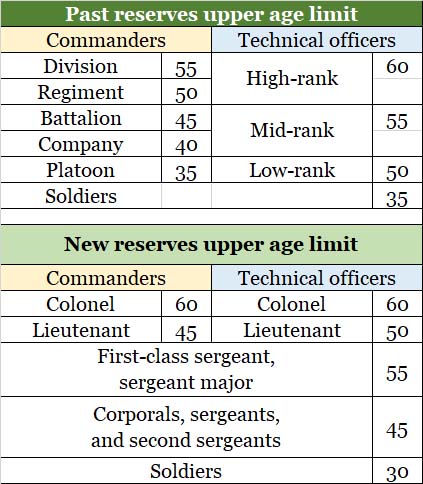
Before 2021, the PRC’s military service law (兵役法) sets the service age of reserve soldiers at 18 to 35, and adds that their service “can be extended appropriately according to needs.” After a revision to the law in 2021, the maximum service age of reserve soldiers could be changed “in accordance with other relevant laws and regulations.”
The table below compares the past and future upper age limits for the various reserve personnel:
Our take
The CCP is enhancing its military-preparedness by raising the upper age limit for military reserves. For one, Beijing is observing the Russia-Ukraine war and drawing lessons from it, and likely determined that it has to lengthen the service period of its reserve officers and noncommissioned officers to retain command capability in the event of war.
The CCP has also likely factored in China’s demographic problems in raising the military reserves age limit. China’s working age population was 876 million in 2022, or 6.66 million fewer than in 2021. This population will only shrink further with each year, leaving the PLA with fewer eligible men to draw upon if it does not extend the service of its reserves.
Increasing the upper age limit now, however, does not mean that the CCP plans to imminently invade Taiwan or carry out other acts of aggression (see items 1 and 2 of this newsletter). Rather, the CCP appears to have an eye on objectives a little further down the road, including getting invasion-ready by 2027 and completing military modernization by 2035. The CCP is possibly also widening its pool of available military personnel now in case of a “Black Swan” event where geopolitical tensions suddenly spiral out of control and it finds itself needing to defend PRC borders in a global conflict.
4 HK chief executive, pro-Beijing figure ‘explain’ foot-dragging on Article 23
Feb. 13
Hong Kong Chinese language newspaper Ming Pao published an op-ed by Lo Man-tuen, vice chairman of the pro-Beijing All-China Federation of Returned Overseas Chinese. Lo argued that legislative work to pass Article 23 of the Hong Kong Basic Law should not be carried out this year and it is not even appropriate to start public consultations on the subject.
Lo listed four reasons why the Hong Kong government should delay the passage of Article 23:
- Hong Kong’s most pressing task at present is embarking on full-scale economic development and controversial matters should be set aside for the time being. Also, Hong Kong already has the “guaranteed bottom” of the National Security Law, which means that it is “not very urgent to develop legislation for Article 23, which can be slowly and carefully planned.”
- With the PRC carrying out comprehensive “multilateral diplomacy” after the pandemic, Hong Kong should be maximizing its advantages and potential, as well as strengthening its ability to connect with the world.
- Taiwan is holding its presidential election next year and campaigning will begin in the second half of 2023. If Hong Kong legislates Article 23 now, Taiwan’s Democratic Progressive Party could seize the opportunity (撿到槍) to further discredit “one country, two systems,” win votes, and stay in power to promote “Taiwan independence” and block the process of “peaceful reunification.”
- The international situation is rapidly evolving. Therefore, more time is needed to carefully study, evaluate, and plan for the passage of Article 23 to meet the requirements of the new situation.
Gary Chan Hak-kan, the vice chairman of the pro-Beijing Democratic Alliance for the Betterment and Progress of Hong Kong and chairman of the Legislative Council Panel on Security, responded to Lo Man-tuen’s op-ed by calling for the opposite, that is, the Hong Kong government should speed up the passage of Article 23. Chan claimed that “there are other voices in society” that want Article 23 to be legislated “as soon as possible.”
Feb. 14
Hong Kong chief executive John Lee Ka-chiu said that the Hong Kong Special Administrative Region has a constitutional responsibility to pass Article 23 “as soon as possible.” He added that the goal is to complete the legislation “as soon as this year, and if not, next year,” repeating remarks that he made earlier on Jan. 17. The bill would then be enacted “according to actual circumstances” and “when the time is right.”
In responding to Lo Man-tuen’s view, Lee said that “not everyone may fully grasp the seriousness of the problems that Article 23 is supposed to target, because the risks of national security keep changing.” He added that “international relations are complex, and national security risks still lurk in Hong Kong.” Therefore, “it is necessary to comprehensively consolidate the multi-faceted mechanisms for maintaining national security.”
Background and backdrop
Article 23 requires Hong Kong to enact its own national security legislation. An earlier effort by the Hong Kong government to pass it in 2003 failed after it sparked a mass demonstration with an estimated 500,000 participants. The 2003 effort was widely viewed by observers as an attempt by Jiang Zemin and the faction associated with him to export Jiang’s persecution campaign against Falun Gong to Hong Kong. We gave a fuller history of Article 23 and Falun Gong, including developments in recent years, here.
The recent attention on Article 23 comes amid the following noteworthy developments:
Jan. 12: A Hong Kong court rejected the Hong Kong justice department’s application to review the verdict of a Falun Gong case in June 2022. The court previously ruled that Falun Gong practitioner “Ms. Dong” was not guilty of a charge by the Hong Kong Food and Environmental Hygiene Department, who accused her of “displaying posters without permission” at Tung Chung Station Bus Terminus.
Jan. 27: The Hong Kong government submitted 34 bills for deliberation and passage in the current legislative year (ends December 2023), none of which concerned Article 23, according to Hong Kong media reports.
Feb. 1: The Institute of International Finance found that mainland China and Hong Kong had supplied around 40 percent of Russia’s total semiconductor imports. The IIF noted that “it is still unclear whether all chips are prohibited by the U.S. for exports to Russia.”
Feb. 3: A Hong Kong court ruled that Hong Kong Falun Gong practitioner “Ms. Zeng” was not guilty of “displaying posters on government land without permission” in displaying a Falun Gong information board at a flyover in 2021. This is another case in which Falun Gong practitioners in Hong Kong successfully appealed and won cases brought up by the Hong Kong Food and Environmental Hygiene Department.
Our take
1. Lo Man-tuen is a former delegate to the National Committee of the Chinese People’s Political Consultative Conference and an authoritative figure in Hong Kong’s pro-Beijing camp. It is likely that his op-ed in Ming Pao is representative of the Xi leadership’s current thinking about enacting Article 23 in Hong Kong. By having Lo publish his op-ed, Beijing appears to be both offering an explanation about why it is delaying the passage of Article 23 to its supporters in Hong Kong and using an authoritative figure to “suppress” dissenting voices who are eager to see Article 23 legislated.
Despite the view of some observers and the framing of some news reports, John Lee’s response to Lo Man-tuen’s op-ed actually complements what the latter had put forth. Beijing will eventually want Hong Kong to pass Article 23, just not at the moment. Lee’s remarks also help insulate him somewhat from criticism from some in the Hong Kong pro-Beijing camp or pro-Jiang Zemin faction elements who are pressuring his administration to enact Article 23 and may not be happy that the bill will not go through this legislative year.
The remnant Jiang faction and other “anti-Xi” forces would be hoping that the Hong Kong government moves as quickly as it can on Article 23 and angers the international community. The Xi leadership would suffer another failure in Hong Kong if the U.S. and its allies sanction the HKSAR government and the PRC authorities over the further erosion of Hong Kong’s freedoms by passing Article 23. More setbacks for Xi will undermine his “quan wei” at home and leave him vulnerable to a serious intra-Party challenge to his leadership.
2. Lo Man-tuen’s four reasons to delay the passage of Article 23 affirm our analysis in early October 2022 about Xi Jinping relaxing “zero-COVID,” refocusing on the economy, improving relations with Taiwan, patching up diplomatic ties with other countries, and making other moves that could shock his critics after securing his 20th Party Congress agenda.
Lo’s reasons also indirectly indicate that Hong Kong and mainland China’s economies are performing very poorly at present. This leaves Beijing with no choice but to withdraw the “wolf warrior” approach and step up diplomacy to “meet the requirements of the new situation” and facilitate regime survival.
3. The Hong Kong government and Beijing’s current stance on Article 23, as well as the continued legal successes of Falun Gong practitioners in Hong Kong, suggest that Xi Jinping is still holding on to the “Falun Gong card” in Hong Kong (see here, here, here, here, here, and here).
We assess that Xi will likely only play the “Falun Gong card” if his personal political situation is seriously threatened (i.e. Xi is in real danger of being removed like the “Gang of Four”) by his factional enemies and other “anti-Xi” forces at home and abroad, primarily because Falun Gong is a third-rail issue for the CCP regime that concerns its moral and ideological legitimacy.
4. John Lee has said that the Hong Kong government is looking to pass Article 23 in 2023 or 2024. But both dates seem remote at present given Xi Jinping’s factional struggle considerations and mounting geopolitical problems.
We believe that Beijing would only feel comfortable giving the Hong Kong government the go-ahead on Article 23 under the circumstance that the CCP regime is not in serious danger of being targeted by international sanctions and other punishment over eroding Hong Kong’s freedoms, and should Xi be fully convinced that the remnant Jiang faction and other “anti-Xi” forces are no longer a danger to his rule. Of course, Beijing could also rush Hong Kong to pass Article 23 immediately regardless of the current considerations in the event of mass protests or other great “stability maintenance” problems in the territory.