

SinoInsight 1
On May 26, “China Comment” (Ban Yue Tan, 半月談), a CCP mouthpiece magazine, ran an article titled, “Salary Delays, Bonuses Deducted: Some Towns and Villages Run Into Difficulties in Guaranteeing Operations, Issuing Regular Salaries” (工資滯發、獎金被扣:部分鄉鎮保運轉,正常待遇兌現難). The article noted that some local governments in western China have delayed payment of wages and bonuses to town or village-level cadres, which in turn affected grassroot government operations.
Some town or village officials who spoke to “Ban Yue Tan” said that the problem of delayed wages and bonuses is very common in their area. An official said that performance bonuses (worth 1,000-plus yuan per month) in 2020 had been withheld and still have not been issued today. Another official complained of struggling to make ends meet after not having received their basic salary for two months. Yet another official said, “I used to help the poor daily; today I’m about to become an ‘impoverished household.’” However, “China Comment” wrote that no officials dare to abandon their job because they are afraid of being reported through various channels and risk being disciplined.
The “China Comment” article noted that with their salary being withheld, town or village officials are losing their will to work because their job is not very attractive to begin with—low wages, heavy workload, high pressure. The article cited a county-level official from a western region in China as saying, “Some cadres don’t want to work and are unwilling to work. It’s hard to find candidates for office directors, section chiefs, and station masters in various towns, villages, and departments. Nobody wants to do [various official jobs]; department chiefs have to rely on treating people to lunch and social relations to hire people.”
***
Li Dongyu, a member of the national Chinese People’s Political Consultative Conference and vice chairman of the Shaanxi Provincial CPPCC, proposed optimizing county-level administrative divisions at the Two Sessions in March.
Li first observed that population outflows are more serious in areas with smaller populations and less developed economies. A certain western county lost 52 percent of its population, she added. Local governments of sparsely populated counties, however, are still required to set up the full Party-state administrative system (Party Committee, People’s Congress, local CPPCC, local political and legal affairs apparatus, local propaganda apparatus, etc.). This can put huge financial pressure on those local governments: Li noted that a certain county in 2019 had a population of 30,200, local fiscal revenue of 36.61 million yuan, and a general public budget expenditure of 865 million yuan. The high expenditure was due to the local county government needing to support more than 120 administrative and social organizations that hired over 6,000 staff, or a “financial support” ratio of one local person to five local officials.
Li then proposed piloting the merger of small counties (population of less than 100,000) to cut down on the wastage of administrative resources and optimize the allocation of “production factors” (生產要素 ).
Mainland media has been scrutinizing Foping County in Shaanxi Province over the past two months.
Foping County is one of the one China’s 50 least populous counties (Inner Mongolia: 1; Xinjiang: 2; Qinghai: 7; Tibet: 39), with a registered population of 30,000. Permanent county residents, however, only number around 8,000, with many younger people becoming migrant workers.
Despite having a small population, Foping County has 2,194 government staff, or an official to civilian ratio of 1:13 (twice the national average). Mainland media reports say that there is a 1-kilometer stretch of road in the county with government buildings from 13 departments on both sides; Foping even has a Maritime Safety Administration despite Shaanxi being a landlocked province. In the last three years, Foping County’s fiscal revenue was 71.798 million yuan (2018), 62.622 million yuan (2019), and 33 million yuan (2020) respectively, while its fiscal expenditure was 800 million yuan (2018), 797 million yuan (2019), and 772 million yuan (2020) respectively. The bulk of Foping’s fiscal expenditure was spent on civil servant wages.
Foping is administered as a county because it contains an important water source for the South–North Water Transfer Project and is an attractive tourism spot being a natural habitat for protected animals like the giant panda, crested ibis, and snub-nosed monkey. A remote area, Foping has no McDonald’s or KFC, while there are only nine taxis in the Foping and no online ride-hailing service. However, Foping does have a high-speed rail (“two stations, five lines” scale) that is active during the holiday season; the county is “deserted” in the off-season.
***
China has more than 2,800 county-level administrative regions. Over 200 counties have a population of less than 100,000, and about half of those counties (mostly concentrated in western China) have a population of less than 50,000.
OUR TAKE
1. The CCP maintains a massive bureaucracy to strengthen its control over the localities and safeguard regime security. The downside of big government, however, is the costs of supporting an enormous civil service and various government entities. Beijing has attempted to trim the PRC civil service on multiple occasions throughout the years to cut costs and make its massive bureaucracy more efficient, but government entities and staff usually end up growing, not shrinking.
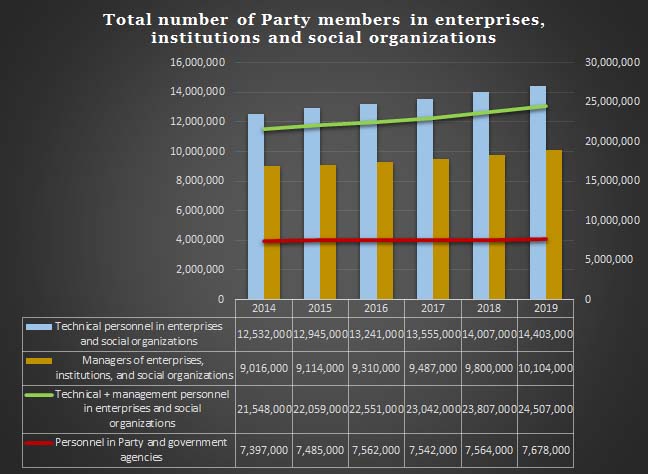
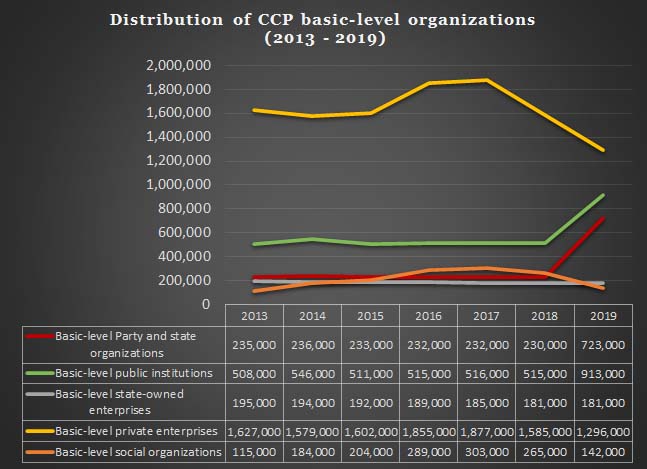
From the tables above, we can see that despite Party and state institutional reforms in 2018, the CCP has not only failed to trim government staff, but has added more people to the bureaucracy. In 2019, there were an additional 493,000 (up 214.3 percent) basic-level Party organizations and 114,000 (up 1.5 percent) Party members at those organizations as compared to a year ago. That year also saw the addition of 398,000 (up 77.3 percent) more public institutions and 700,000 Party members (2.9 percent) at those institutions from the previous year.
Still, a massive, costly bureaucracy may not be a terrible thing if it functions satisfactorily. However, the CCP’s returns on investment in big government have been poor, with Party culture-steeped local officials often putting their personal interests (crazy borrowing sprees, wasteful projects for the sake of accruing political capital, corruption, etc.) before regime interests, and in the process, saddling the central government with their risks.
A deteriorating Chinese economy is also driving people to find security in so-called “iron rice bowl” jobs in the Party and the bureaucracy. From Table 1, the total number of Party members working in Party and state jobs in 2019 was 32.185 million, or over a third of the 90 million-plus Party members in the PRC. However, not everyone working for a Party or state organization is a Party member, and the number of non-Party members working for the CCP’s massive bureaucracy almost certainly exceeds that of Party members; according to CCP media reports, there were more than 64 million people on government payroll in 2014.
2. China’s shrinking population and regional economic imbalance explain why basic-level governments in western China are running into financial difficulties.
Per the CCP’s 2020 national census data, 376 million people, or about 26.5 percent of the total population, are part of China’s migrant population. The bulk of migration flows in one direction—people from impoverished, under-developed areas moving to wealthy, developed urban areas along China’s southeast coast. From 2000 to 2010, only four provinces—Guizhou (minus 490,000), Chongqing (minus 1.66 million), Sichuan (minus 1.93 million), Hubei (minus 2.27 million)—saw their populations shrink. Another six provinces—Gansu (minus 550,000), Inner Mongolia (minus 650,000), Shanxi (minus 790,000), Liaoning (minus 1.15 million), Jilin (minus 3.37 million), Heilongjiang (minus 646 million people)—joined the list from 2010 to 2020. Meanwhile, Guangdong, one of the wealthiest provinces in China, added 10.8 million people in 2020.
People naturally gravitate to richer parts of the country to make a living and escape demographic-related problems. This trend worsens the hollowing out of more backward areas of China and increases the strain on local government resources given the current rigidity of Party-state system operations with each passing year. Basic-level government fiscal problems are locked into a vicious cycle: Those who remain in sparsely populated areas enter the civil service due to poor economic conditions and for career security, leading to those areas becoming even more uncompetitive and unattractive to the migrating population. As their economic performance progressively worsens, even more people leave those areas or join the civil service.
Beijing is well aware of the ongoing crisis. Hence, senior Party leaders emphasized securing the “six guarantees,” or “employment, basic livelihood, market entities, food and energy security, supply chain stability, and operations of basic-level institutions,” in March 2020. Current efforts at sustaining “operations of basic-level institutions” may not be enough given recent attention to the state of basic-level government in China’s poorer western areas. CCP basic-level operations will face great challenges if the Chinese economy continues to deteriorate.
3. In analyzing China’s property market problems in 2019 and 2020, we noted that the CCP could protect the property markets in first- and second-tier cities while “abandoning” those in the third- and fourth-tier cities in the event of a crisis. Likewise, if there is generic economic trouble everywhere, Beijing would be naturally inclined to preserve the first- and second-tier cities over the lower tier, less crucial cities and areas as part of its overall crisis management strategy.
The CCP’s gradual “abandoning” of third- and fourth-tier cities and under-developed parts of China may not immediately affect Chinese markets. However, businesses, investors, and governments should not be deceived by the “all’s well” illusion that the Party is almost certain to project because the demographic, bureaucratic (massive and passive), and economic problems haunting less developed areas in China will eventually hit the first- and second-tier cities with a vengeance. More immediately, economic and demographic problems in China’s less well-off areas undercuts the regime’s “1.4 billion people mega-market” myth, meaning that foreign manufacturers will not see the sort of economies of scale promised by the CCP.
SinoInsight 2
May 24
Several Hong Kong media outlets reported on a planned expansion of the Hong Kong and Macao Affairs Office (HKMAO).
Presently, the HKMAO has seven departments: Secretary and administration, general affairs, policy and research, liaison, exchange and cooperation, law, and institutional Party committee (personnel). The CCP plans to add two more departments to cover national security and propaganda, according to Hong Kong media. According to a mainland source to the South China Morning Post, the changes correspond to the elevation of the central coordination group (工作協調小組) overseeing the HKMAO to a leading group (領導小組).
Wang Zhenmin, the former Hong Kong Liaison Office legal affairs director from 2015 to 2018, is tipped to head the HKMAO national security department. Wang was previously appointed to the Hong Kong Basic Law Committee in February 2006. While serving as Liaison Office legal affairs director in 2017, Wang notoriously slammed those in Hong Kong who are critical of the CCP as having “granite brains” during a seminar on the Basic Law that was held as part of events marking the 20th anniversary of the Hong Kong handover. Wang Zhenmin is currently the director at the center for Hong Kong and Macau Research at Tsinghua University.
Yang Guang, a HKMAO spokesperson who gave press conferences where he condemned the anti-extradition bill protests in 2019, will reportedly head the HKMAO propaganda department.
May 27
The Hong Kong legislature passed a bill to enact sweeping Beijing-approved electoral reforms in Hong Kong, including the implementation of so-called “patriots ruling Hong Kong.”
OUR TAKE
1. The above information is likely reliable as it fits with Xi Jinping and the CCP’s agenda for Hong Kong.
The CCP, driven by survival and dominance, fears that “hostile foreign forces” will take advantage of the Hong Kong pro-democracy movement and mass protests to transform the city into a “counter-revolutionary base” from which to undermine the mainland. Naturally, the Party would want to elevate its handling of Hong Kong and Macao affairs and strengthen its control over Hong Kong through “stability maintenance” (national security) and influencing public discourse (propaganda).
Xi also has a personal stake in tightening control over Hong Kong. Hong Kong cannot be allowed to become an “anti-Xi base” from which domestic and foreign enemies undermine the Xi leadership in the lead up to the 20th Party Congress when Xi Jinping is expected to make a bid for a norm-breaking third term in office. And per the CCP’s standard playbook, the best way to control a recalcitrant area is through the Party’s “pen” (propaganda) and “knife handle” (political and legal affairs apparatus).
Xi is putting his personal stamp on Hong Kong by extending his national security supra-authority organization to the city, setting up a new state-owned cultural institution to sway public discourse, sidelining Jiang faction officials overseeing Hong Kong (Zhang Xiaoming) while placing trusted officials (Luo Huining and Xia Baolong) in key positions, heavily reshuffling personnel at the Hong Kong Liaison Office, having Liaison Office director Luo Huining jointly serve as deputy director of the HKMAO, and elevating the central coordination group above the HKMAO to a leading group. Beijing also appears to be behind a new pro-CCP political party (Bauhinia Party), whose formation is likely designed to challenge disloyal pro-Beijing elements in Hong Kong. All in all, Xi is bringing the CCP’s chain of command in Hong Kong more directly under himself.
2. The recent Hong Kong electoral reforms and efforts by the CCP to control public discourse through various means indicate that Party Central is not at ease with the pro-Beijing Hong Kong elite. On one level, Xi Jinping is concerned about the true loyalties of the Hong Kong elite, many of whom were “captured” by the Jiang faction during its long era of dominance (1997 to 2012). On another level, the CCP fears that the Hong Kong elite—particularly those who lived under British rule or received Western education but benefited from collaboration with Beijing in the past two decades—are ultimately loyal to their self-interests and not the Party. This is especially problematic at a time when the CCP has to increasingly prioritize regime security over meeting the expectations of the Hong Kong elite.
Hence, Beijing is concurrently sidelining the current crop of establishment Hong Kong elites while grooming a new batch in conjunction with its other efforts to tighten its grip over the city.