◎ The CCP is concerned about the rapidly worsening Chinese economy and fearful of escalating “new cold war” with the United States.
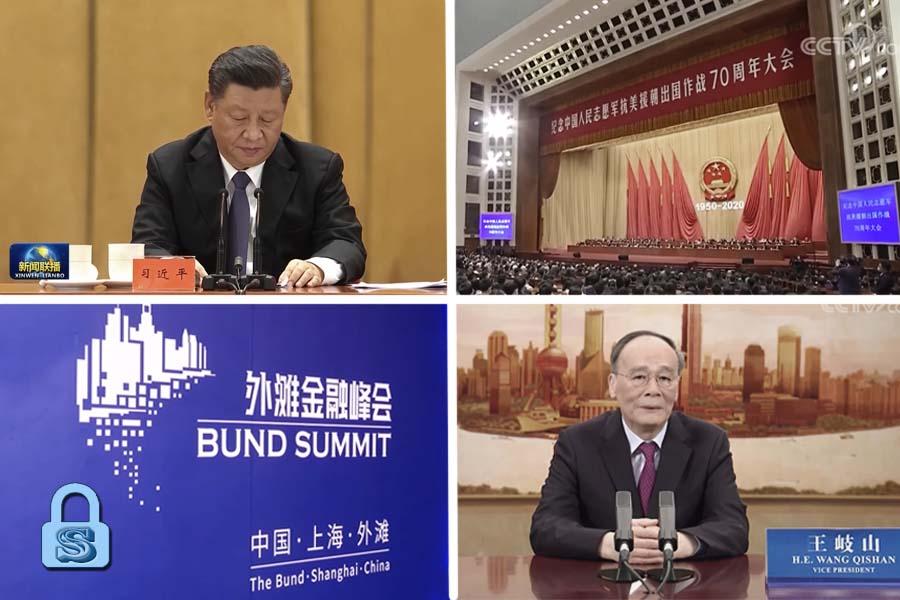
On Oct. 23, Chinese Communist Party General Secretary Xi Jinping delivered a speech to commemorate the 70th anniversary of the Korean War, or in Party parlance, the “War to Resist U.S. Aggression and Aid Korea.” A day later, Xi’s top ally and deputy, People’s Republic of China vice president Wang Qishan, made a rare public appearance at a financial forum in Shanghai to speak about “domestic circulation” and financial risks.
At a glance, both Xi and Wang seem to be rehashing Party propaganda, cliches, concepts, and other familiar talking points in their respective speeches. Parse the subtext, however, and the speeches of Xi and Wang reveal the CCP’s concerns and fears amid a rapidly worsening Chinese economy and an escalating “new cold war” with the United States.
Below, we highlight key parts of both speeches and analyze the subtext.
Xi’s speech
1. Xi Jinping’s Korean War speech largely repeats CCP propaganda history about the conflict. Lessons are then extracted from propaganda for coping with the regime’s current crises, particularly the “new cold war” with the United States:
- Xi claims that the CCP’s “victory” is billed as “a declaration that the Chinese people have stood firm in the East, and an important milestone in the Chinese nation’s march toward the great rejuvenation.”
- “Imperialism will never again dare to take the new China by force, and the new China is truly on firm footing.”
- CCP “victory” in the Korean War “smashed the aggressors’ plot to nip the new China in the bud” and “helped Chinese people completely get rid of the label of the ‘Sick Man of East Asia.’”
- The “victory” left the world with “new respect” (刮目相看) for Communist China and “advanced the modernization of China’s national defense and the armed forces.”
The Korean War broke out after North Korea invaded South Korea in 1950 with Mao Zedong’s blessings and backing. North Korea’s aggression drew condemnation from the United Nations Security Council and saw U.S.-led United Nations forces enter the Korean Peninsula to push back the invaders. The CCP formally entered the fray on the side of its sister communist regime after feeling threatened by U.N.-U.S. successes in turning back the North Korean invasion and then starting a rapid advance into North Korea. After a prolonged stalemate and intermittent fighting, an armistice was signed in 1953. The conclusion to the Korean War was less than satisfactory for the communist side—North Korea lost about 1,500 square miles of territory when the line at the 38th parallel was redrawn under the armistice agreement.
In CCP propaganda, the Korean War is framed as the “war to resist U.S. aggression and aid Korea” and the outcome is “victory” for the communists. Per the CCP’s retelling of events, it sent a “volunteer force” into North Korea because the U.S.-led United Nations troops crossed the 38th Parallel with intentions to invade Communist China; the part where North Korea invaded the South is omitted. The CCP’s largely volunteer “army of justice” (正義之師) then fought a “just war,” sustained heavy casualties, and won a “great victory” (偉大勝利) against U.S. imperialism.
At the macro level, Xi’s Korean War speech continues the CCP’s long-term effort to brainwash the Chinese people into accepting Party rule over China. Historical setbacks and events that resulted in less than satisfactory outcomes for the CCP are rewritten and framed as “victories” per the classic propaganda tactic of “spinning tragedy into cause for celebration” (喪事當喜事辦). Deception is endemic to the CCP, and the “reappropriation” of history is consistent with a Marxist-Leninist regime’s dialectical materialist approach to seizing and keeping power.
2. The CCP is signaling parallels between its Korean War “victory” and the current Sino-U.S. conflict. For example:
- Xi said: “In today’s world, the pursuit of unilateralism, protectionism and extreme egoism won’t work! Any method of blackmail, blockade and extreme pressure won’t work! Any behavior … that engages in hegemony, tyranny, and bullying won’t work!” Given that the CCP has used similar language to criticize the Sino-U.S. trade war and other U.S. efforts to address the “China challenge,” Xi’s remarks are meant to be a thinly-veiled swipe at America.
- On the same day as Xi’s speech, the English language edition of state mouthpiece Xinhua ran a commentary titled, “War commemoration a timely warning to anti-China ‘paper tigers.’” Per the commentary, “Arrogance, always doing as one pleases, acts of hegemony, overbearance or bullying will lead nowhere and surely result in a dead end in today’s world, as Xi said in his speech. This is a lesson some politicians in the West must keep in mind when they try to blackmail, block and exert maximum pressure on China.” The CCP sometimes puts in effort to “explain” or “translate” certain views and concepts (obscure Chinese sayings, Party speak, etc.) in its propaganda so that foreigners are clear on what it is trying to signal. For instance, China Daily published a piece explaining how to translate an uncommon Chinese saying (“我將無我,不負人民”) that was the highlight of what Xi Jinping said to Italian Chamber of Deputies president Roberto Fico when they met in 2019. The English edition of People’s Daily made sure Xi’s phrase is not misunderstood by a foreign audience by directly translating the meaning of it and putting it in the headline (“Xi vows to be selfless, devoted to the Chinese people”). For the most part, CCP propaganda organs “say one thing in English, and another in Mandarin,” as Secretary of State Mike Pompeo noted. In the case of the “paper tiger” Xinhua commentary, the CCP wants the U.S. to know that Xi’s Korean War speech is, in part, aimed at putting America on notice.
In his speech, Xi downplays the CCP’s push for international hegemony and warns those who seek to harm the regime’s interests:
- “China never seeks hegemony or expansion and firmly opposes hegemonism and power politics. We will never sit idly by and allow China’s national sovereignty, security and development interests to be undermined, and will never allow any individual or force to impair or divide this sacred territory. When such serious incidents occur, the Chinese people will meet them head on!”
- “When we lag behind we will take a beating, the only way to strengthen ourselves through development” (落後就要挨打,發展才能自強).
Here, Xi is flipping the role of “aggressor” and “victim” by projecting the CCP’s global ambitions and actions onto the United States. Xi’s “take a beating” line is a throwback to the CCP’s “Century of Humiliation” narrative, according to which only the CCP has the capacity to have China stand up again and become a strong country. U.S. efforts under the Trump administration to seek reciprocity with China and counter the CCP’s intellectual property theft, trade abuses, espionage, efforts to achieve global hegemony through technology (5G rollout), and bullying of Taiwan and other neighboring countries through diplomatic and military means are obliquely cast as U.S. attempts to restore the “Century of Humiliation” and hurt the CCP’s “development interests.” In other words, Xi and the CCP are reframing the Sino-U.S. new cold war similarly to how the Party reframed the Korean War. The fact that the CCP needs to again reframe a Sino-U.S. conflict suggests that it is currently taking a beating but has to pretend otherwise. Xi’s remarks about “national sovereignty” and “divid(ing) this sacred territory” is a reference to Taiwan, and reflects the CCP’s fears that strengthening U.S.-Taiwan ties will undermine its political legitimacy. All in all, Xi’s attempt to flip the script with his Korean War speech is consistent with the CCP’s “survival-dominance” dynamic.
Xi’s “warning” to the U.S. may amount to bravado and empty words because the CCP will try to, where possible, avoid action that unduly escalates the current Sino-U.S. conflict. The propaganda effect of Xi’s “development interests” remarks is also undercut by earlier “Amazing China!” (厲害了,我的國) propaganda, which presents the PRC as “rising as a great power” and even “exceeding America.” Already, some Chinese netizens have noted mockingly that China always seems to be “taking a beating” (挨打) regardless of whether they are “lagging behind” the “imperialists” or have now supposedly “outmatched” them in technology and other areas.
3. Xi Jinping “reminds” the Chinese people in his speech that the CCP led them to “victory” over the U.S. “aggressors” during the Korean War and to prosperity:
- “Sixty years after the War to Resist U.S. Aggression and Aid Korea, China has undergone tremendous change under the resolute leadership of the Chinese Communist Party. Socialism with Chinese characteristics has entered a new era, and the Chinese people have stood up and taken a flying leap forward from being rich to strong.”
- “In the face of risks and challenges from all sides, and in the face of resistance and pressure, the Chinese people have been opening up new paths and building bridges in every situation, as well as demonstrating their wisdom, courage, and determination to ‘carve out a bloody path’ to forge ahead.”
- “The great victory in the War to Resist U.S. Aggression and Aid Korea proves once again that no political force can be like the Chinese Communist Party in sacrificing blood and sweat in its unremitting struggle for national rejuvenation, the people’s happiness, and the unceasing march towards victory.”
- “[The Chinese Communist Party] must adhere to the fundamental purpose of serving the people wholeheartedly, work for the people, be responsible for the people, assume responsibilities for the people, take the people’s aspiration for a better life as an unswerving goal to struggle towards, and maintain the flesh-and-blood ties between the Party and the people.”
- “Let us unite around Party Central, carry forward the spirit of great resistance against the United States and aiding Korea, and march forward “gallantly and with full vigor” (雄赳赳、氣昂昂) on the journey towards building a great modern socialist country and achieve the goal of national rejuvenation.”
Xi and the CCP’s goal here is three-fold. First, they are taking full credit for “victory” during the Korean War, as well as the “uplifting” of the Chinese people in the over six decades period after the war. Second, they want the Chinese people to trust and rally around the Party, just like during the Korean War, as it navigates the Sino-U.S. new cold war. Third, by equating the Party and the Chinese people, they are looking to use the Chinese people as a “human shield” and hostages in the current U.S.-China conflict. For instance, the CCP will sell all ills resulting from U.S. efforts to counter its malign behavior as “U.S. imperialists are putting down the Chinese people” to direct the Chinese people’s anger towards an external enemy (America) instead of the guilty party (the CCP).
Underlying Xi’s remarks in his Korean War speech is the CCP’s grave fear of ideological battle with the United States. We previously explained why the CCP is afraid of ideological confrontation and why it will not directly address the matter (see here and here). The fact that Xi needs to emphasize “maintain(ing) the flesh-and-blood ties between the Party and the people” and “remind” the Chinese people of the Party’s role in helping them “stand up” underscores the effectiveness of Washington’s ideological warfare (drawing a clear distinction between the CCP and the Chinese people, outing the Party’s Marxist-Leninist ideology, calling attention to its gross human rights violations, etc.).
Wang’s speech
Wang Qishan delivered his speech at the 2020 Shanghai Bund Summit, a forum attended by Chinese economic and financial elites, active and retired regime officials, academics and diplomats, as well as foreign financiers.
Wang mainly elaborated on how the PRC plans to tackle economic problems and financial risks stemming from a world in turmoil (coronavirus, etc.) through “domestic circulation” (内循環):
- “The momentum of the international circulation where China’s economic markets and resources are located has significantly weakened in recent years. Meanwhile, the contribution of domestic demand towards economic growth is growing stronger.”
- “We will adhere to the principle of making progress while seeking stability, implement a new development concept, and accelerate the construction of a new development pattern with domestic circulation as the mainstay and international circulation in support.”
- “We will shift China’s economic growth momentum from being driven by input to innovation, and being driven by investment to consumption.”
Despite talk of “opening up” China’s financial sector to a greater degree, Wang Qishan and Xi Jinping are planning to move ahead with a partial closing up of China (a move we spotted in early 2019). The CCP’s policies to “liberalize” the financial sector are meant to facilitate the inflow of precious foreign funds to sustain the partial closing up of the regime. The plan to partially close up China is largely a response to the Sino-U.S. new cold war, while U.S. trade and tech sanctions—as well as ideological warfare—represent an existential threat to the CCP regime. Yet despite the hype, the CCP’s “dual circulation” or “domestic circulation” model is ultimately unsustainable (see here, here, and here).
Wang also hinted that the CCP will stick to its own solutions instead of relying on external models to resolve financial risks in China:
- “Exploring the path of financial development with Chinese characteristics is a long-term, complex, and arduous task.”
- “We need to stick to our bottom line, but also respond flexibly and responsively to risk challenges.”
- “Financial services must serve the real economy. Financial services divorced from the real economy is like water without a source and trees without roots. China’s financial sector should not follow the crooked path of speculation and gambling, the circuitous side path of financial bubbles, or the pernicious path of Ponzi schemes.”
Here, Wang Qishan has rearticulated Xi leadership’s plan since the 18th Party Congress (2012) to de-risk China’s financial sector, de-financialize the Chinese economy, resolve the debt crisis, and grow the real economy. Wang has also made it clear that while Beijing will “liberalize” China’s markets, it will not allow Western-style financialization to develop and compound financial and economic risks. Indeed, while the CCP will respond “flexibility and responsively to risk challenges” by allowing more foreign investors to park their funds in China, Wang is clear that the Party will “stick to [its] bottom line” when financial issues threaten the regime (former Chongqing mayor Huang Qifan made a similar point in early October).
In reading the subtext, Wang Qishan and Xi Jinping know that the regime needs foreign funds to survive, but are guarded against greater financialization and the risks they present. Wang and Xi are also laying down markers for the financial elite and reminding them that the political elite ultimately holds sway in the PRC.
Conclusion
Since the release of its third quarter GDP figures in mid-October, the CCP has been aggressively promoting its “economic recovery” and “control” of the coronavirus. And in their respective speeches, Xi Jinping and Wang Qishan boast about Communist China’s ability to deal with adversity and setbacks with ideologically-driven solutions. Their propaganda, however, also reveals the CCP’s concerns and fears about the impact of an escalating Sino-U.S. new cold war on the Party’s political legitimacy. As the U.S. rolls out more consequential actions to tackle the “China challenge” in the days ahead, the CCP’s “paper tiger” accusation will ring hollow as another attempt at self-projection.