
◎ We have identified four tactics which the CCP is utilizing to carry out its “judo move.”
In analyzing the Hong Kong situation, we previously wrote that the Chinese Communist Party is “completely capable of utilizing controversial and drastic methods to achieve its agenda.” In the short-term, the CCP is looking to pacify Hong Kong before October 1, or the 70th anniversary of the founding of the People’s Republic of China. In the long-term, the CCP wants to make “two systems” (Hong Kong’s “high degree of autonomy” versus authoritarian PRC) more like “one country” (the PRC) before 2047, or the year when the “one country, two systems” arrangement is set to expire in Hong Kong.
Thus far, we have explained how the CCP is working to achieve its Hong Kong agenda by “advancing to retreat,” deploying “chain stratagems,” and making preparations to sacrifice Hong Kong’s business and political elite. Based on our recent observations, we believe that the CCP is also currently executing a “judo move” by using and boosting the momentum of protester violence to discredit and take down the entire anti-extradition bill movement.
The ‘judo move’
The anti-extradition bill protests were widely acclaimed for being peaceful and civic-minded when they first broke out in June. As the protesters had the clear moral high ground, the heavy-handed police and security force action against the protesters turned out to be bad optics for the CCP. To justify using hardline tactics to suppress the protests, the CCP must first discredit the Hong Kong protesters in the eyes of local residents and the international community. Based on our understanding of the CCP, we believe that it is behind recent incidents that have led to the increased radicalization of the protest movement. Increased radicalization erodes the protesters’ moral high ground and allows the CCP to “use” the momentum of radicalization to perform a “judo move.”
The CCP’s “judo move” against the protesters is two-fold: First, terrorize the Hong Kong protesters and residents in general. Second, manipulate the protesters, and particularly the so-called “brave martial clique” (勇武派), to behave lawlessly and carry out more and more acts of violence.
In the CCP’s ideal scenario, increased protester violence will cause the protest movement to lose popular support locally and in the international community. The violence will also give the security forces in Hong Kong a ready-made excuse and greater justification for clamping down even harder on the protesters. Ultimately, the CCP will be looking to use and boost the momentum of protester violence carried out by a small segment of protesters to defeat larger protest movement without making further concessions on its part (like meeting the remaining four of five protester demands).
We have identified four tactics which the CCP is utilizing to carry out its “judo move.”
Infiltration
We previously wrote that the CCP favors “deploying agents to infiltrate groups, fracture the group and its cause, and provoke violence with the authorities to give the CCP a ready-made reason to launch a crackdown. The Tibetans, Uyghurs, protesters in Tiananmen Square, and retired military veteran protesters were all victims to CCP incitement tactics.”
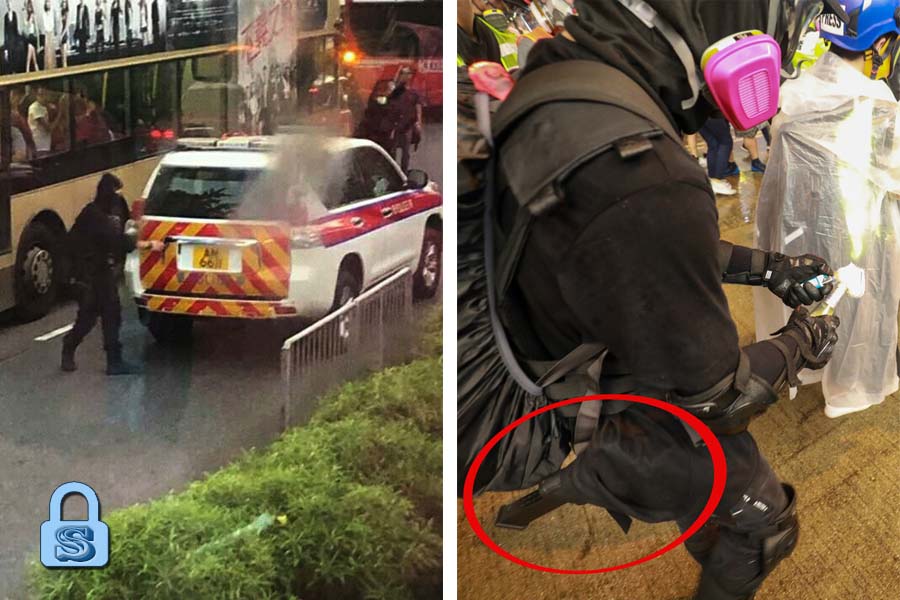
There are ample video and photo evidence circulating on the internet of Hong Kong police and other security forces dressing up as protesters to infiltrate the protest movement. This activity has also been reported on by the Hong Kong and international press.
Infiltrating protests is a common police and security force tactic around the world. The goal of such infiltration, particularly in democratic countries, is intelligence-gathering. The police and security forces in Hong Kong, however, appear to be infiltrating the protest movement to engage in incitement. Undercover police have been filmed hurling Molotov cocktails at riot police; setting bonfires on the streets; as well as vandalizing train stations and other public property. Such actions inspire copycat moves from real Hong Kong protesters and make the protest movement more violent.
Intimidation
The CCP frequently employs intimidation as a tactic to control the masses on the mainland. Intimidation creates a climate of fear and terror, with the goal of frightening the masses into not challenging the authorities.
The police and security forces in Hong Kong have been documented using excessive force against the protesters, and police brutality itself is a form of intimidation. Meanwhile, pro-CCP groups and Hong Kong triad thugs have been intimidating protesters through verbal abuse and wantonly beating them up in public.
There were three prominent cases of intimidation on Sept. 24:
- At about 10:00 a.m., Hong Kong Democratic Party lawmaker Roy Kwong was assaulted by three people close to his home in the district of Tin Shui Wai. A fourth person filmed the assault. Kwong injured his cervical vertebrae and was hospitalized.
- At around 4:00 p.m., Falun Gong adherent Ms. Liu was beaten up by two assailants in the Lai Chi Kok. The assailants appeared to be wielding police batons and left her. bleeding from the head. Ms. Liu had to go to a hospital to receive treatment for her wounds. Just before the assault, Ms. Liu and two of her friends were at a police station applying for a permit to hold a Falun Gong protest march on Oct. 1.
- At about 8:00 p.m., a female reporter with Hong Kong newspaper Apple Daily and her friend were suddenly assaulted by four burly men while they were at dinner in Sau Mau Ping District. The reporter and her friend sustained multiple injuries. Before leaving, one of their assailants said to the reporter, “Tell your boss Fat [Jimmy] Lai to return the money!”
Protesters initially responded to intimidation by triad thugs and pro-CCP groups by reporting them to the police. However, fear of the police and lack of police action after reports were filed have led some protesters to take matters into their own hands. In videos widely circulated on Sept. 21, both male and female protesters are seen surrounding and beating up an elderly man at a street corner, leaving him dazed and bleeding from the head. The man was identified as a prominent pro-CCP heckler who frequently abused the protesters in public and even assaulted some of them earlier. Some international observers and journalists, however, upheld the beating of the pro-CCP heckler as an example of protesters engaging in unprovoked violence, possibly because they were unaware of the full picture. All in all, the protesters’ desperate response (even female protesters have begun to partake in assaults) to CCP intimidation tactics are costing them the moral high ground while giving the CCP grounds for “justifying” tough action against the protesters.
Elimination
Observers who track human rights issues in the CCP regime will be familiar with cases where dissidents or others whom the Party have targeted for persecution mysteriously “commit suicide” while in the hands of mainland security forces.
Since late August, there has been a sharp uptick in the number of “suicides” and “bodies found” in Hong Kong. Other odd cases include:
- Protesters believe that at least three protesters succumbed to their injuries after being beaten by police at the Prince Edward MTR station on Aug. 31, and were subsequently disposed of. This is partly because the authorities revised the number of injured people who were taken to the hospital that day for treatment from 10 to seven. The Hong Kong authorities have strongly denied the rumors.
- In the evening of Sept. 22, Hong Kong netizens reported that plainclothes police were patrolling an area near the beach. The following day, the police announced the “discovery” of a supposedly drowned body along the beach. However, eyewitnesses say that the body showed no swelling from drowning and instead was bleeding profusely, which lead some observers to doubt the police announcement of the cause of death.
- Hong Kong netizens report on social media and in online forums that protesters being held in San Uk Ling Holding Centre, a detention center near the border with mainland China, are being mistreated, tortured, and in the case of female detainees, raped. According to news reports, 31 of 54 protesters arrested on Aug. 11 were later hospitalized, with six of the 31 suffering bone fractures. Lawyers and Hong Kong justices of the peace have complained that they are either denied or delayed entry to the detention center to see their clients.
If security forces in Hong Kong are indeed behind the mysterious deaths and “suicides” in recent weeks, then the “suicides” and their discovery are likely deliberate attempts at intimidation and psychological warfare against the Hong Kong protesters.
Incitement
We previously wrote that incitement is a favorite tactic of the CCP. Infiltration, intimidation, and elimination all serve the purpose of inciting the Hong Kong protesters to violence. The CCP is also capable of manipulating the Hong Kong authorities or pro-Beijing elements to take actions which result in the provocation and incitement of Hong Kong protesters and residents.
We believe that the CCP had a hand in two recent incidents which sparked huge outrage in Hong Kong society.
On Sept. 13, pro-Beijing lawmaker Junius Ho promoted a “Clean Hong Kong Day” event on Sept. 21 where he urged his supporters and pro-CCP groups to tear down “Lennon Walls” across the city. “Lennon Walls” are displays of Post-it notes that call for democracy and denounce the Hong Kong government and the CCP regime. Ho faced strong public backlash and later toned down his rhetoric on Sept. 20 and told participants of his event to avoid conflict.
During a press conference on Sept. 23, Hong Kong acting police superintendent Vasco Williams said to a reporter: “You mentioned a video which shows what appears to be an officer kicking a yellow object on the ground. Now, we don’t know what that object is, but there are other videos that are more clear that show the entire incident and there’s no malpractice by the police whatsoever in the clear video.” Williams’s “yellow object” remark was severely criticized by the public, with many using the word “anger” in describing how they felt about the incident. Some observers noted that Williams’s vocabulary fit with what many believe to be a deliberate attempt by the Hong Kong police to “dehumanize” the Hong Kong protesters through the language in which they are referred to (“cockroaches”) and rationalize brutal police action.
The ultimate goal of incitement is the fracturing of Hong Kong society and the protest movement. Once Hong Kong is sufficiently fractured, the CCP will attempt to quell the protest movement in one fell stroke and seize the opportunity to ramp up the “normalization” of the city, i.e. tighten CCP control over Hong Kong and carry out brainwashing efforts to make its residents “love the country, love Hong Kong” (愛國愛港).
What’s next:
1. CCP disinformation and psychological warfare operations take many forms. The “judo move” which we described above is one type of disinformation campaign aimed at changing local and foreign perception toward the Hong Kong anti-extradition bill protests.
The CCP’s “judo move” has already seen some success in swaying international opinion against the protest movement. But barring even more nefarious moves or unforeseen circumstances, we believe that the CCP’s tactic will more likely than not backfire.
First, the majority of the protesters remain peaceful, law-abiding, and nonviolent (合理非), and some of the more obvious CCP intimidation tactics have been captured in full view of the public. We assess that the protest movement will likely gain more, and not less, support in Hong Kong. Increased provocation by the police, the local triads, and the pro-CCP groups could inspire even more people to take to the streets during the many rallies and protests organized around Oct. 1. Future protest marches with three million or more participants are a real possibility.
Second, the United States could boost its support for the Hong Kong protesters and criticize the CCP regime when Sino-U.S. trade talks next break down. And the international community would likely follow America’s lead on Hong Kong.
2. We previously examined the role of the “you die, I live” CCP factional struggle between the Jiang faction and the Xi camp in Hong Kong. As such, we do not rule out the possibility that the Jiang faction is behind some of the more recent intimidation efforts against the protesters to heighten their anger. After all, the world will blame Xi Jinping for increased police violence and attacks on protesters. Also, record numbers of people taking to the streets in Hong Kong to protest the CCP as it celebrates the 70th anniversary of the PRC’s founding is a huge embarrassment for Xi and will affect his quan wei (權威). Ultimately, the Jiang faction would want to force Xi into ordering a Tiananmen-style crackdown in Hong Kong.
